
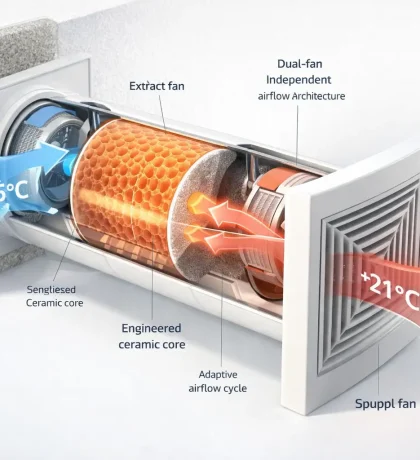
ENGINEERED AIRFLOW TECHNOLOGY
Dual-Fan Regenerative Ventilation Architecture
Independent supply and extract fans combined with a purpose-engineered ceramic heat and moisture accumulator enable stable regenerative heat recovery and controlled airflow in cold-climate buildings.
• True dual-fan airflow architecture
• Engineered ceramic heat and moisture accumulator
• Controlled cyclic airflow for stable operation
Engineered for real buildings. Optimized for Northern European climate.
True Dual-Fan Regenerative Airflow Architecture
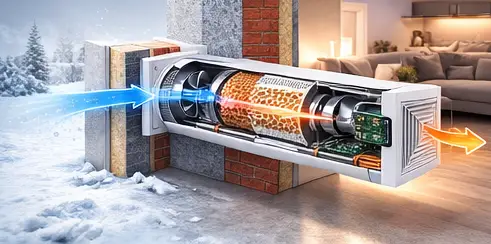
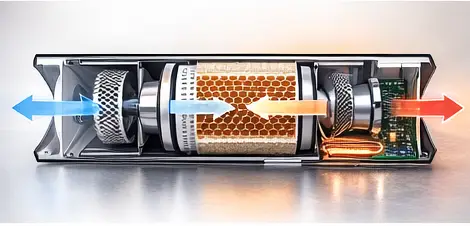
ARS Nordic regenerative ventilation systems use a true dual-fan architecture with two physically independent airflow paths — one for air supply and one for air extraction.
Unlike conventional single-fan decentralized systems that rely on motor reversal to alternate airflow direction, ARS Nordic systems use separate marine-grade EC fans operating exclusively in their designed direction. This eliminates airflow interruption, reduces mechanical stress, and ensures stable aerodynamic performance.
Each fan operates independently, with configurable speed and cycle timing, enabling precise control of airflow balance, pressure behavior, and thermal transfer. This enables stable regenerative heat transfer within the ceramic accumulator while maintaining balanced ventilation under real building pressure conditions.
Because airflow supply and extraction are physically separated and electronically controlled, the system maintains predictable thermal behavior and consistent heat recovery performance.
Key engineering advantages:
• Independent supply and extract airflow paths
• No motor reversal and no airflow direction switching
• Continuous, stable airflow during regenerative operation
• Reduced mechanical wear and increased system longevity
• Stable aerodynamic performance across all operating conditions
• Precise airflow control for pressure-balanced ventilation
• Independent speed and cycle control for supply and extract airflow
This architecture provides the mechanical and aerodynamic foundation required for advanced adaptive airflow control and stable operation in cold-climate environments.
Adaptive Airflow Cycle Control
ARS Nordic regenerative ventilation systems are built on independently controlled supply and extract fans with fully configurable operating cycles.
Unlike conventional decentralized units that operate with fixed or symmetric airflow timing, ARS Nordic systems allow independent adjustment of both fan speed and operating duration for supply (IN) and extract (OUT) airflow.
Each fan features 10 selectable speed levels and programmable cycle periods. This enables precise airflow balancing under real building conditions where passive air infiltration, stack effect, wind pressure, or combustion appliances influence internal pressure behavior.
By adjusting airflow intensity and cycle timing asymmetrically, the system can compensate for uncontrolled air movement and maintain stable thermal regeneration inside the ceramic accumulator.
For example, extract airflow can operate at higher speed or longer duration than supply airflow to counter passive air inflow or to stabilize ventilation in buildings with fireplaces or vertical air shafts.
This control strategy ensures:
• Independent speed control for IN and OUT fans
• Adjustable operating periods for supply and extract cycles
• Compensation for passive infiltration and pressure variations
• Stable indoor temperature during regenerative operation
• Optimized heat recovery efficiency across seasonal conditions
• Reliable performance in multi-storey and pressure-sensitive environments
Cycle timing can be configured according to seasonal requirements.
Typical cold-climate winter configuration may prioritize longer extract cycles to maximize heat storage in the ceramic accumulator, while supply airflow delivers preheated air in controlled intervals.
During warmer seasons, cycle balance can be adjusted to maintain thermal comfort and prevent unnecessary heat retention.
This adaptive airflow control architecture allows ARS Nordic systems to operate not as fixed-timer devices, but as dynamically balanced ventilation systems designed for real-world buildings.
Distributed Regenerative Ventilation System Architecture
ARS Nordic decentralized ventilation systems are designed to operate as coordinated airflow units distributed throughout the building.
Instead of relying on a single centralized ventilation system, multiple regenerative ventilation units are installed in separate rooms to create controlled air exchange across the entire living space.
Each unit operates with alternating extract and supply airflow cycles. When multiple units operate asynchronously, pressure differences between rooms create natural air movement paths throughout the building.
This distributed airflow interaction prevents stagnation zones and ensures continuous air circulation even in enclosed or distant areas of the building.
Unlike single-unit operation, coordinated multi-unit deployment enables:
• Continuous air exchange between rooms
• Elimination of localized pressure imbalance
• Improved ventilation efficiency across the entire building
• Stabilized indoor temperature and humidity distribution
• Effective air movement without centralized duct systems
This architecture allows buildings to maintain stable indoor air quality while preserving thermal energy recovered within each ceramic accumulator.
ARS Nordic systems are specifically engineered to operate reliably in airtight modern buildings, renovated apartments, and cold-climate residential environments.
QUARTO Four-Fan Balanced Ventilation Architecture
Standard decentralized regenerative ventilation systems are designed to operate in coordinated pairs installed in separate rooms. This allows one unit to extract air while another supplies air, maintaining balanced pressure across the building.
However, in single-room applications such as studios, small apartments, or isolated spaces, installing multiple units is not always possible.
To solve this limitation, ARS Nordic developed the QUARTO architecture — an integrated four-fan ventilation system that enables fully balanced airflow operation within a single installation point.
The QUARTO system combines two independent regenerative airflow modules operating asynchronously inside one unit.
At any given moment:
• one airflow path extracts indoor air
• the other airflow path supplies fresh air
• airflow directions alternate in controlled regenerative cycles
• internal pressure remains stable without creating vacuum or overpressure
This architecture ensures continuous ventilation while maintaining thermal regeneration efficiency inside the ceramic accumulator.
Key engineering advantages of QUARTO architecture:
• True balanced ventilation within a single room
• No pressure imbalance during operation
• Continuous supply and extract airflow interaction
• Stable operation in airtight buildings
• Improved comfort in studios and single-space environments
• No need for paired installation across multiple rooms
The QUARTO system maintains predictable airflow behavior even in pressure-sensitive environments such as multi-story buildings or spaces with combustion appliances.
This enables reliable regenerative ventilation performance in applications where conventional decentralized systems cannot operate effectively.
Marine-Grade Dual EC Fan System
ARS Nordic regenerative ventilation systems use two independent marine-grade EC fans designed for continuous, long-term operation in demanding environments.
Unlike reversible single-fan systems, ARS Nordic architecture uses dedicated fans with fixed airflow direction:
• IN FAN — supply air fan
• OUT FAN — extract air fan
Each fan operates exclusively in its optimized direction, eliminating motor reversal, improving efficiency, and increasing mechanical reliability.
Marine-grade fan design ensures stable performance under real-world environmental conditions, including temperature fluctuations, humidity, and continuous operation.
Key engineering characteristics:
• Independent supply and extract fans
• No motor reversal during operation
• Marine-grade durability and long service life
• Low acoustic noise suitable for residential environments
• Energy-efficient EC motor technology
• Designed for continuous 24/7 operation
This dedicated dual-fan configuration ensures predictable airflow behavior and stable regenerative heat transfer under all operating conditions
Engineered Ceramic Thermal and Moisture Accumulator
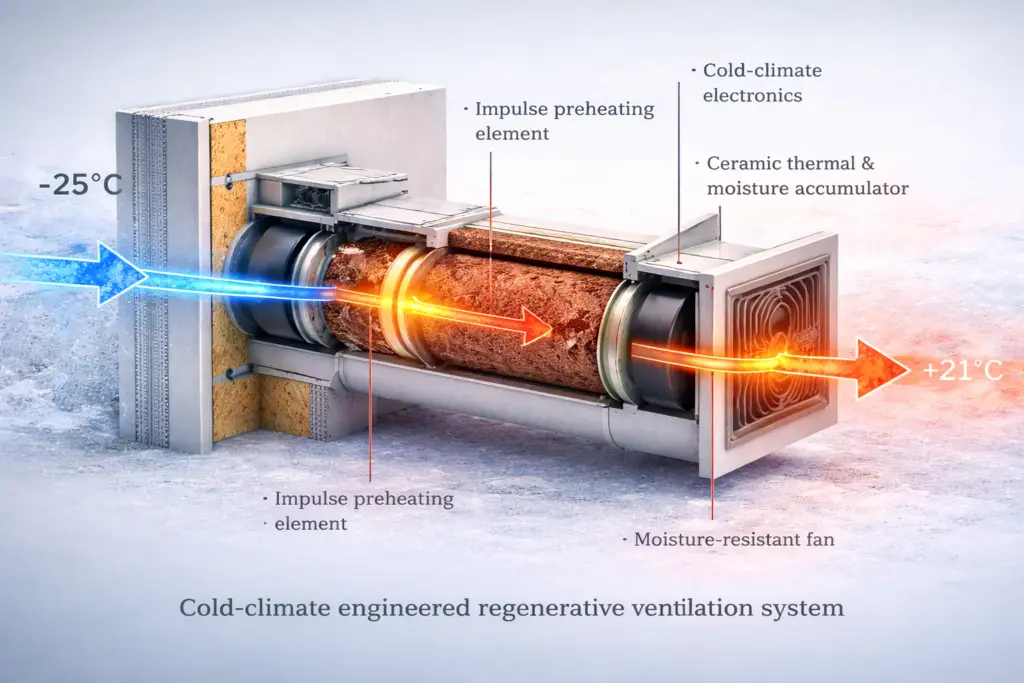
At the core of ARS Nordic regenerative ventilation technology is a purpose-engineered ceramic thermal accumulator designed for rapid heat and moisture exchange.
Unlike conventional dense ceramic materials that rely primarily on mass for heat storage, ARS Nordic ceramic accumulators use a specialized material composition and controlled internal microstructure optimized for fast thermal response and efficient moisture interaction.
This engineered structure enables the ceramic core to function as a dynamic thermal and moisture buffer rather than a passive heat mass.
During extract operation, warm indoor air transfers heat and moisture into the ceramic accumulator.
During supply operation, incoming fresh air absorbs stored thermal energy and regulated moisture, stabilizing indoor temperature and improving comfort without additional energy input.
Because heat transfer occurs through a high-surface-area engineered structure rather than slow conduction through dense material, the accumulator responds quickly and maintains stable regenerative performance even under varying airflow and environmental conditions.
Key engineering characteristics:
• Specialized ceramic composition engineered for regenerative heat transfer
• Optimized internal microstructure for rapid thermal exchange
• Efficient heat storage and controlled release during airflow cycles
• Moisture buffering capability for improved indoor comfort
• Fast response to changing airflow and temperature conditions
• Stable operation in cold-climate environments
This engineered ceramic accumulator forms the thermal foundation of the ARS Nordic regenerative ventilation system, enabling efficient heat recovery, stable indoor conditions, and reliable performance in real-world buildings.
Cold-Climate Protection and Stability Engineering
ARS Nordic regenerative ventilation systems are engineered specifically for reliable operation in cold and variable Northern European climate conditions.
Unlike standard decentralized units that may experience unstable airflow, condensation imbalance, or performance degradation at low outdoor temperatures, ARS Nordic systems maintain stable regenerative operation across a wide temperature range.
The system integrates adaptive airflow cycle control, engineered ceramic thermal buffering, and independent supply and extract airflow paths to ensure continuous and predictable performance even in sub-zero conditions.
During cold-weather operation, extract airflow transfers thermal energy into the ceramic accumulator, while controlled supply airflow delivers pre-warmed fresh air into the room. This process stabilizes internal temperatures, reduces thermal shock, and maintains indoor comfort.
Independent fan control allows airflow timing and intensity to be adjusted according to real building conditions, compensating for passive air infiltration, stack effect, and pressure variations common in multi-story and airtight buildings.
This engineering approach ensures:
• Stable heat recovery performance in cold climates
• Reliable operation in temperatures down to extreme winter conditions
• Reduced risk of condensation imbalance inside the system
• Predictable airflow behavior under real building pressure conditions
• Consistent indoor comfort without unnecessary energy loss
Because thermal storage, airflow control, and pressure response are engineered as a unified system, ARS Nordic regenerative ventilation maintains stable and efficient performance throughout seasonal and environmental variations.
System Integration and Real-Building Operation
ARS Nordic regenerative ventilation systems are engineered for stable operation in real buildings, not controlled laboratory conditions.
Each unit operates as part of a distributed ventilation network, where multiple devices work asynchronously to maintain balanced air exchange across rooms and building zones.
Unlike single-direction or synchronized systems, ARS Nordic units use independently controlled supply (IN) and extract (OUT) fans with configurable speed and cycle timing. This allows precise adaptation to real pressure conditions inside buildings.
Asynchronous operation between units prevents the formation of static airflow corridors and enables continuous air movement throughout the entire space, including low-circulation areas.
This distributed airflow architecture is especially important in:
• Airtight modern buildings
• Multi-story residential structures
• Apartments with limited passive air supply
• Buildings with fireplaces or combustion appliances
• Renovated buildings with improved insulation
The system continuously stabilizes indoor air exchange by dynamically interacting with passive airflow, infiltration, and pressure variations present in real structures.
Because airflow, heat recovery, and pressure response are engineered as an integrated system, ARS Nordic ventilation provides reliable, predictable performance under actual operating conditions.
This ensures stable indoor climate, efficient heat recovery, and consistent ventilation without relying on idealized installation conditions.